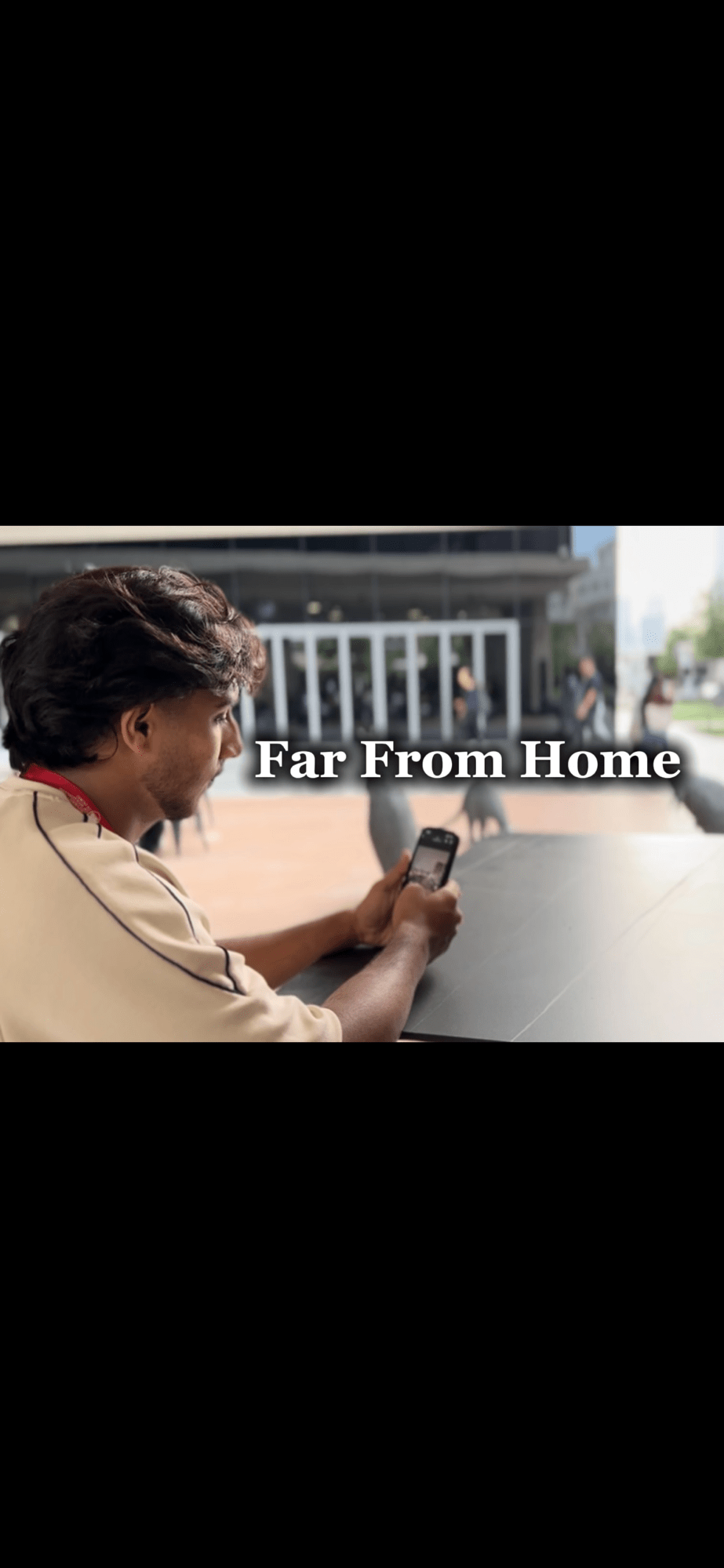
A poetic short film reflecting on identity, belonging and student life in Dubai. A new chapter, new horizons and ultimately new challenges. Life just did a complete 180° and now it’s time to restart and rebuild.
-
-
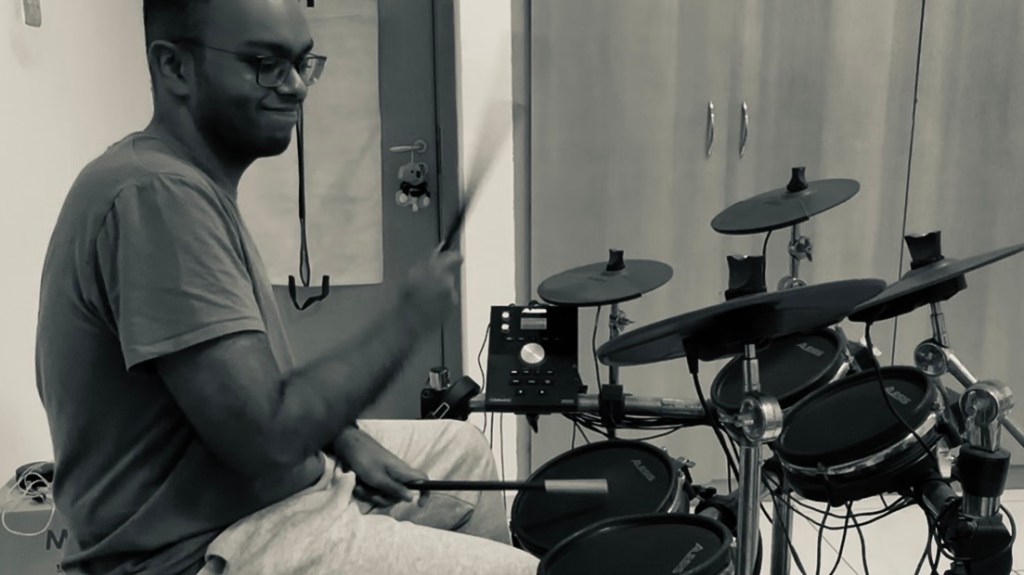
Screenplay/script:
The following script follows an aspiring drummer Joe as he battles both the drum-kit and his own inner demons to chase the perfect take for his drumming audition segment. Take after take, we explore his deteriorating mental state as the frustration builds with every single failed attempt. This film is meant to explore how creativity can slowly morph into self punishment when a person begins to equate their identity through performance.
The shot list is as follows:
Note: AI was used in creating the storyboard visuals.
Shot list pic 1:
1. Introduction and 2. First Struggle
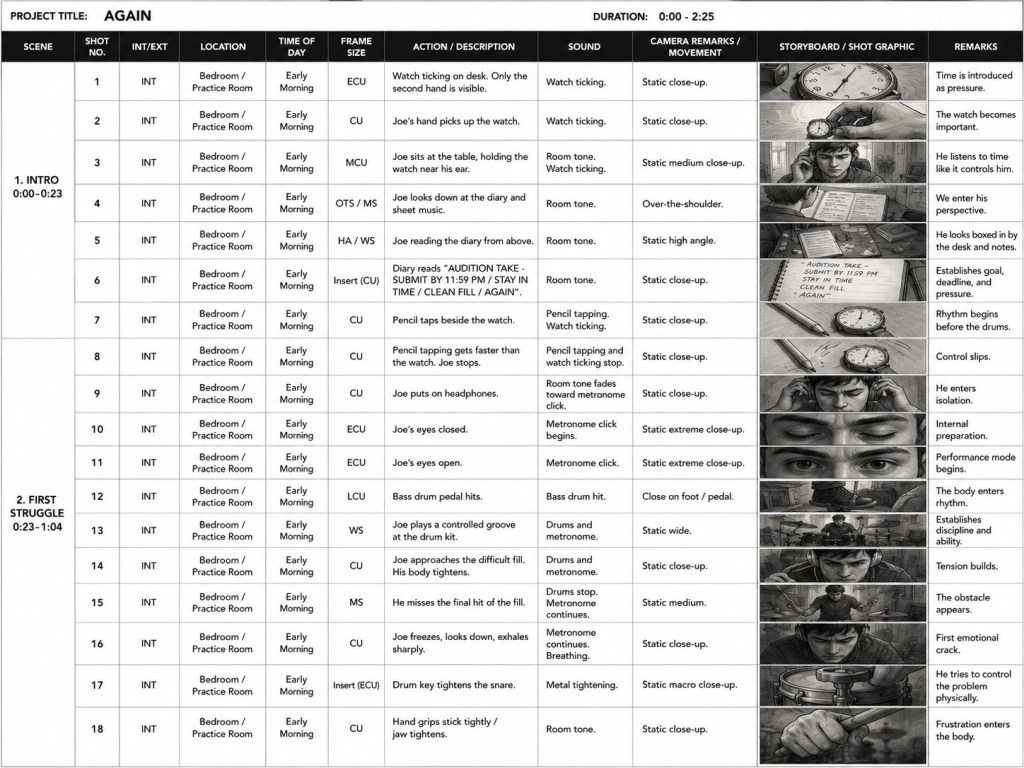
Introduction and First Struggle Shot list 2:
3. Escalation and 4. Climax
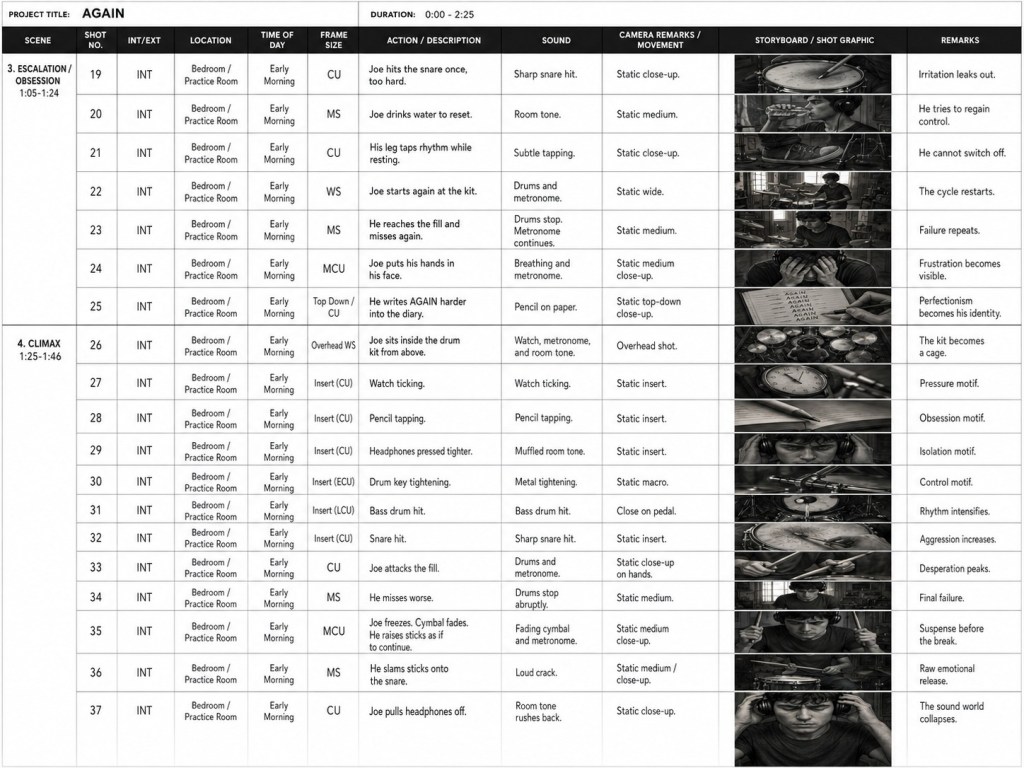
Escalation and Climax Shot list 3:
5. Acceptance/Release
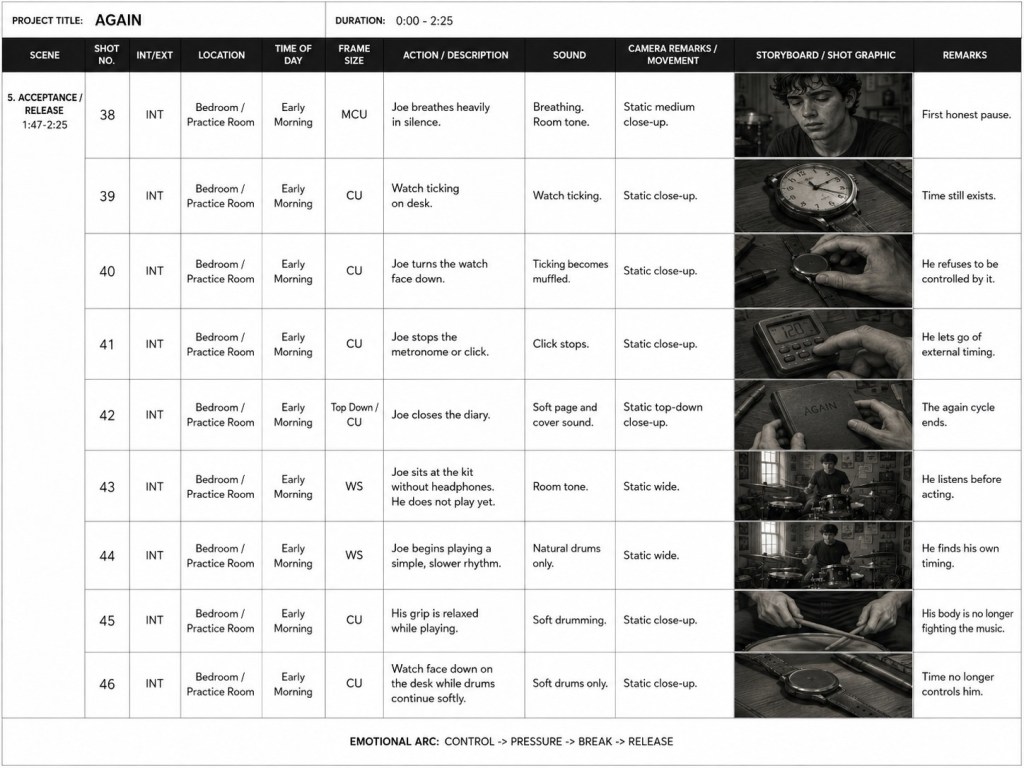
Acceptance/Release Shot-List Excel sheet without storyboard elements
Reflection:
For my character study project, I created a short film titled “Again.” This was primarily centered around a young drummer named Joe who is repeatedly trying to record a smooth audition in the confine of his bedroom. The action is simple and straight forward. Joe repeatedly attempts to play one incredibly difficult drum fill with precision and accuracy of a metronome but is shot down time and time again with failure.
His approach towards performing this task reveals his fragile state of mind, his steadfast commitment to discipline and perseverance and the insurmountable pressure he allows to overwhelm him in order to achieve a seemingly unattainable level of perfection.
The film draws inspiration from Ousmane Sembène’s Black Girl, particularly through use of interior voice over and symbolic objects. In Black Girl, Diouanna’s voiceover gives us a glimpse into a world not unveiled fully to the people around her. In addition, the confines of her apartment space become a place of alienation. The emphasis placed on the African marks holds symbolic significance connecting to identity, resistance and displacement. My film does not try to reproduce the post colonial context of Black Girl, however it does draw inspiration from Sebène’s use of an environment and significant objects to symbolize character’s loss of agency. In Again, Joe’s diary, headphones, and drum key carry that same meaningful weight.
The main point of Again is timing. In music particularly, timing is meant to highlight the importance of control, discipline and technical ability. My approach wanted to sway from that idea and rather showcase how timing can become psychological pressure. The ticking, watch, metronome, pencil tapping and drum rhythm all integrate to show Joe’s inner self. At the beginning, these sounds associated with routine and focus but as the film progresses, they become more obsessive. Joe is not just trying to stay in time but simultaneously fighting the enveloping feeling of time running out.
The mise-en-scène was pivotal to Joe’s character development. The cramped bedroom reflective of a greenhorn youthful energy trying to build an identity from a private room. The watch dictating the feeling of inevitability; pressure and deadlines looming. The diary showcasing the repeated failed attempts and self inflicted criticism. The headphones isolate him and get him to focus back on his task ahead while the drum key becomes a symbol of control. When Joe uses it to tighten the skin of the snare drum, he is metaphorically doing the same to himself internally.
The film also represents a broader social context. The deadline and recording set-up portrays a world where creativity is forever measured, submitted and judged. This showcases the productivity driven culture where young people today constantly find themselves wanting to improve; not for their own wellbeing but to be judged less, constantly proving themselves into burnout.
Visually, the use of repetition and close-ups was to highlight how Joe was trapped in a loop. The overhead drum shot given the drum-kit the setting of a cage, showing how something you’re passionate about can quickly turn into a source of pressure. The voiceover was written to add some perseverance rather than just explaining the action.
By the end, Joe turns the watch face down, switches off the metronome, shuts the diary and plays freely as the film transitions from control to acceptance. Joe does not become perfect by the end. But he discovers sometimes being authentic is much more important.
-
I never envisioned myself in this particular role, but life has a funny way of surprising you sometimes. More so, I never expected for it to ignite a passion in me that would make me test my limits and challenge myself to think deeper about a frame, an angle, a perspective shift. As a cinematographer, I managed to work on the technical and conceptual part of the filmmaking in the same semester. The visual language that I attempted to develop since the initial concept to final shooting was focused around capturing the key themes, authenticity, performance and fragmentation of self, within the documentary.
This project helped me realize the fact that cinematography is not so concerned with beauty as the intentional meaning-making, which is so often based on the long tradition of the world cinema.
I was closely collaborating with the director on pre-production and had to develop symbolism motifs, mirrors, silhouettes, and shifting canvases, and the painter plot. I created shot lists, conducted experimental tests on lighting and visited locations to understand how different settings would support tone and emotion. It is this constant process during the semester that made the process more fluid and allowed the visual language to evolve on its own.
Teamwork was central in the process of production. The rehearsal would be organized as I would meet with the director, discuss the rehearsal with the AD, the producer and coordinate with the sound department to ensure that the lighting rigs would not be disruptive. The art department especially arrived when we had painter sequence when we needed some precision of drip of paint as a symbol and uniformity of the hand held shots of the canvas. This experience on these co-operations made me perfect my communication skills and I understood that the work of cinematography needed synergy within all the departments.
One of the ground shots involved the positioning of the camera behind the catalyst whilst he was speaking to the mirror. This acting is an outright product of film noir and the European psychological film. An example of the application of mirrors to symbolize fractured identity that is well-known is The Lady from Shanghai directed by Orson Welles (Welles 1947), and Ingmar Bergman heavily resorted to concealing faces to create emotional tension as in Persona (Bergman 1966). To investigate the inward and the performed self, I chose the visual reinforcement of the documentary to display how the catalyst expresses himself in a manner that leaves him to be reflected only.
The contrast between these stylized moments and the many sequences of interviews incorporated the Italian Neorealism as well as the French New Wave. Neorealism was also defined by natural light and reality light in surroundings (Zavattini 1952), the New Wave cinematographers like Raoul Coutard thought in imperfect and spontaneous handheld shots (Marie 2003).
The interview with the Business Tycoon needed to be taken differently. In this instance, I was referring to structured official documentary portraiture, which was used in mid-20th century corporate movies. I had put a more stringent emphasis on the topic on the lower part and inserted a rim of stern backlight to the picture forming a silhouette boundary that is grounded on noir chiaroscuro (Naremore 1998). The aesthetic component of the work expressed the struggle of power, identity, and vulnerability – an important conceptual axis of our work.
The Media Specialist interview was inclined towards the basics of the essay-film. Marker and Varda were more prone to place things within a new context that is mediated by media and memory (Marker 1983; Varda 2000). This impressed me, and I grabbed screens, reflections and ambient LED light in the shot to portray graphically the digital saturation. The warmer colour scheme and the push-ins at the moments of reflection were a confirmation of the connection between the media and the self-representation.
The history of similarities between the painter was one of the most productive spheres of historical influence. Even the so-called symbolic shot of a drop of paint, which appears to be represented by the blood directly refers to German Expressionism which used exaggerated shading and symbolic emphasis to project the clash of the psyche (Kracauer 1947). Dripping paint is also what Eisenstein (1949) described as an intellectual montage, which establishes a foreshadowing because of the associative images a slight allusion to the metaphoric death through authenticity.
The lighting played an important theme role. I used flickering lights and high back lighting where there was a change in acts.
The style resonates with horror filmmaking of 1970s, such as Owen Roizman using unsteady practical lights in The Exorcist (Roizman 1973), and the chiaroscuro tradition of noir. Tarkovsky also philosophically used the idea of light as a passage (particularly in Stalker) and this aspect also influenced the decisions (Tarkovsky 1986). The moving of the physical canvas into the digital was also carried by the current studies of medium in the field of cinema. Godard liked to oppose authenticity and construction of images with analog versus digital (Brody 2008), whereas Wong Kar-wai combined different textures to demonstrate fragmented identity (Brunette 2005).
The digitalised canvas in our documentary was represented to depict the edited, fabricated self at the cost of real existence. The colder sound and more digital texture helped to visualize this shift of the themes.
Considering my work experience reflectively, I can account that the symbolic framing of my strengths, the historical consciousness and the ease with which I could collaborate across different departments were the strengths.
Every shot was regarded as the segment of the desired work, and all the visual choices were related to the theme and not just looked good.
However, there are also those things that I would like to improve. I would also take more extensive lighting testing- especially flicker rigs which sometimes got in the way of sound.
Although, I also tended to rely on signature compositions in case future I would have a broader coverage to be able to exercise editorial freedom. It will also help to improve the use of pacing and transitions by being more cooperative with the editor on the earlier stages of the work.
The project enabled me to realize that cinematography is a conversation between the history, purpose, collaboration and emotional resonance. It combined the traditions of noir, Expressionism, Neorealism, and the essay film, and revitalized it to fit interviews, symbolic inserts, and abstract sequences, which allowed me to develop a more personal, more intentionally visual voice.
Most importantly, I was able to get acquainted with how images can reflect, challenge, or undermine the notion of authenticity. The project has helped me enrich my technical knowledge and to appreciate the historical and philosophical aspects of the cinematography.
Thanks for a great semester, Professor Aaron & Daniel! It was a memorable start to my Masters in Media Design degree. Excited for our future courses together!! And ofcourse, huge shout-out to my insanely talented crew members who really brought their A game towards making this documentary a reality!
Production diary:
https://theroughcutcrew.wixsite.com/the-truth-we-almost
Documentary link: https://youtu.be/LlAVG6se6jE
Synopsis:
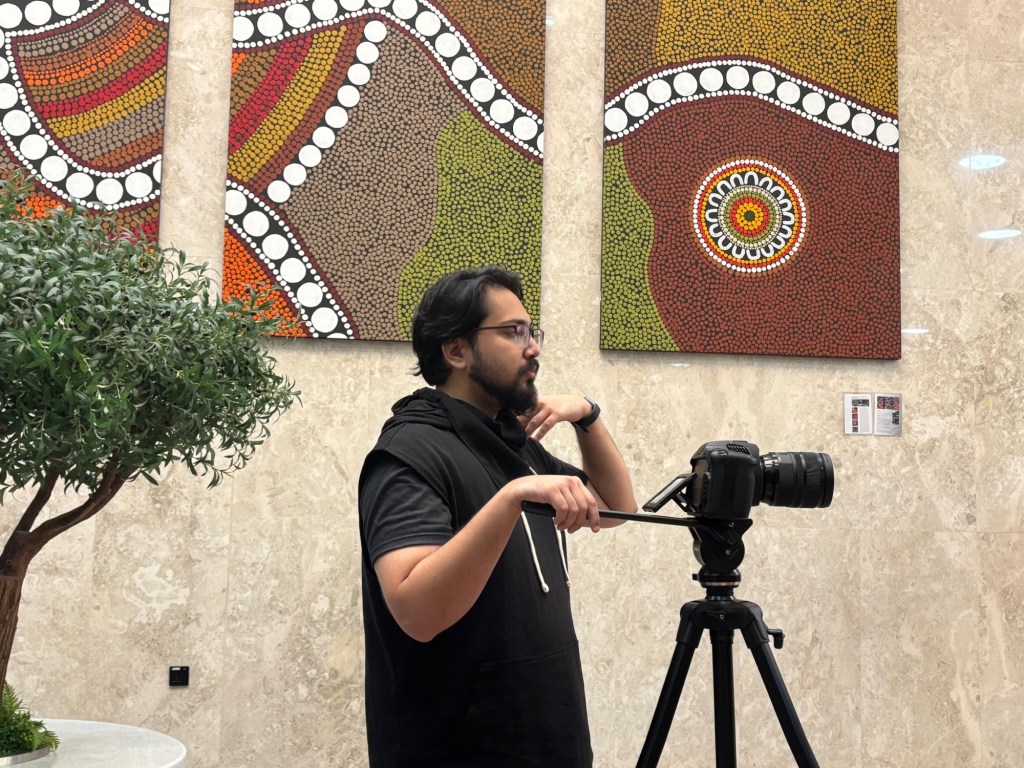
The clash between our real selves and the persona we create to impress will seemingly stand the test of time, especially in this new, uncharted realm of the digital age. Come and explore the RoughCut Team’s perspective on how the struggle for authenticity deserves its own voice and truth!Early days experimenting with the DSLR – Please ignore my awkward hand angles (we all start somewhere) 🙂 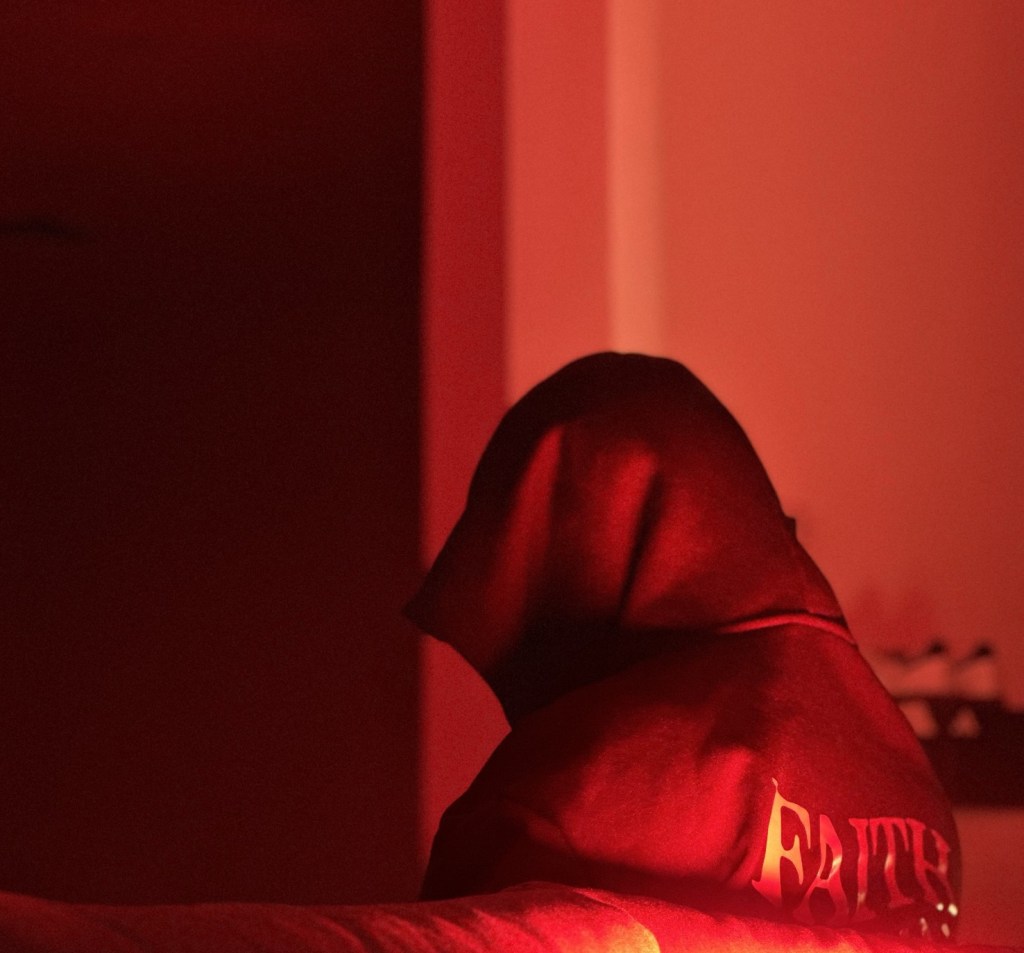
The Catalyst in his element 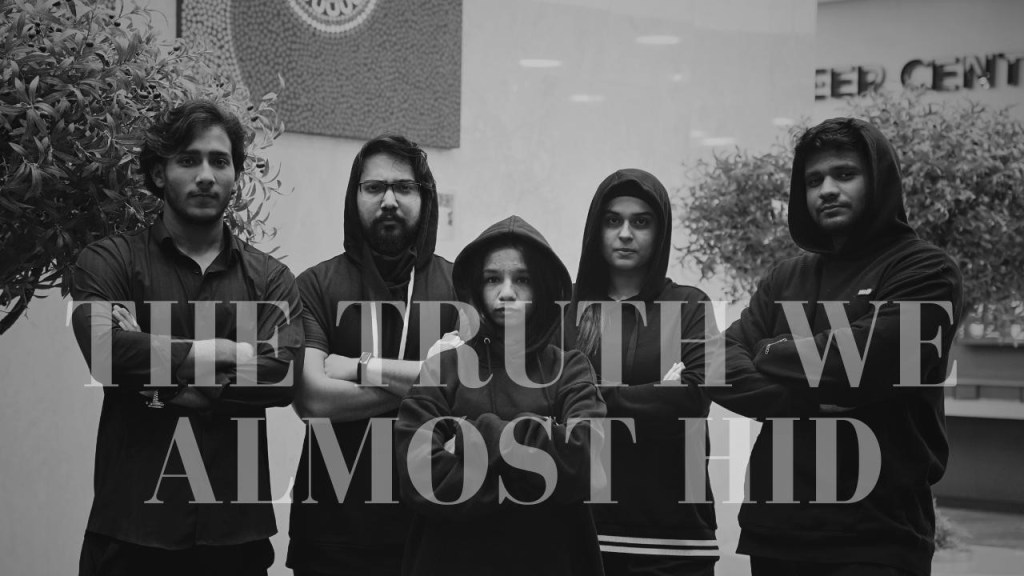
The Roughcut Crew (could not have asked for a better team) Bergman, I. (1966) Persona. Sweden: AB Svensk Filmindustri.
Brody, R. (2008) Everything is Cinema: The Working Life of Jean-Luc Godard. New York: Metropolitan Books.
Brunette, P. (2005) Wong Kar-wai. Urbana: University of Illinois Press.
Eisenstein, S. (1949) Film Form: Essays in Film Theory. New York: Harcourt.
Kracauer, S. (1947) From Caligari to Hitler: A Psychological History of the German Film. Princeton: Princeton University Press.
Marie, M. (2003) The French New Wave: An Artistic School. Oxford: Blackwell.
Marker, C. (1983) Sans Soleil. France: Argos Films.
Naremore, J. (1998) More Than Night: Film Noir in Its Contexts. Berkeley: University of California Press.
Roizman, O. (1973) The Exorcist [Film]. USA: Warner Bros.
Tarkovsky, A. (1986) Sculpting in Time. London: Faber & Faber.
Varda, A. (2000) The Gleaners and I. France: Ciné Tamaris.
Welles, O. (1947) The Lady from Shanghai. USA: Columbia Pictures.
Zavattini, C. (1952) ‘Some Ideas on the Cinema’, Sight and Sound, 21(2), pp. 64–69.

