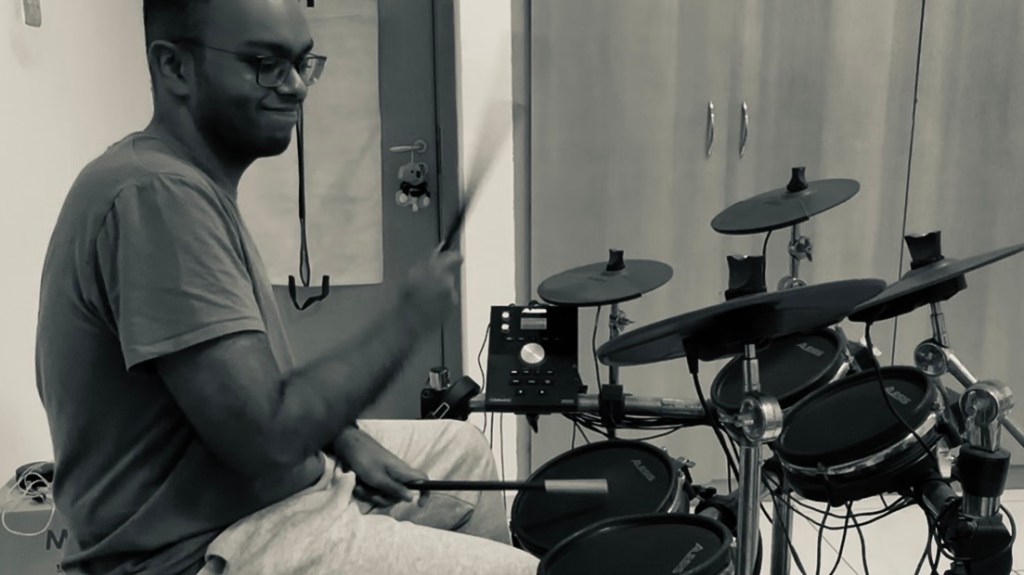
Screenplay/script:
The following script follows an aspiring drummer Joe as he battles both the drum-kit and his own inner demons to chase the perfect take for his drumming audition segment. Take after take, we explore his deteriorating mental state as the frustration builds with every single failed attempt. This film is meant to explore how creativity can slowly morph into self punishment when a person begins to equate their identity through performance.
The shot list is as follows:
Note: AI was used in creating the storyboard visuals.
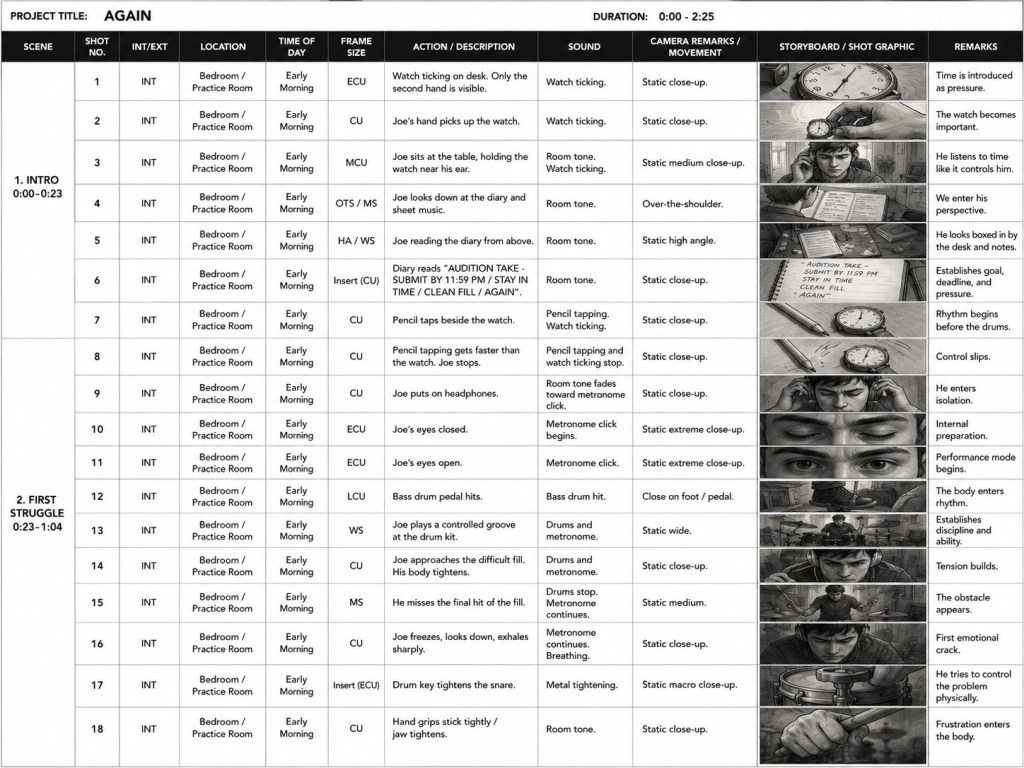
Shot list pic 1:
1. Introduction and 2. First Struggle
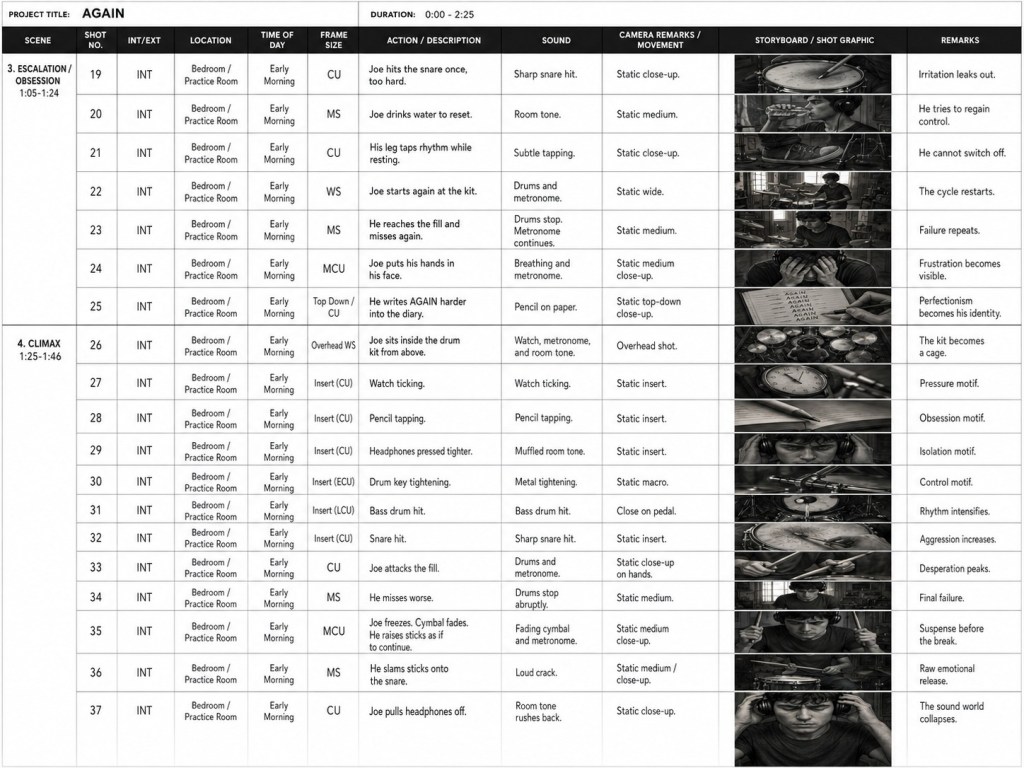
Shot list 2:
3. Escalation and 4. Climax
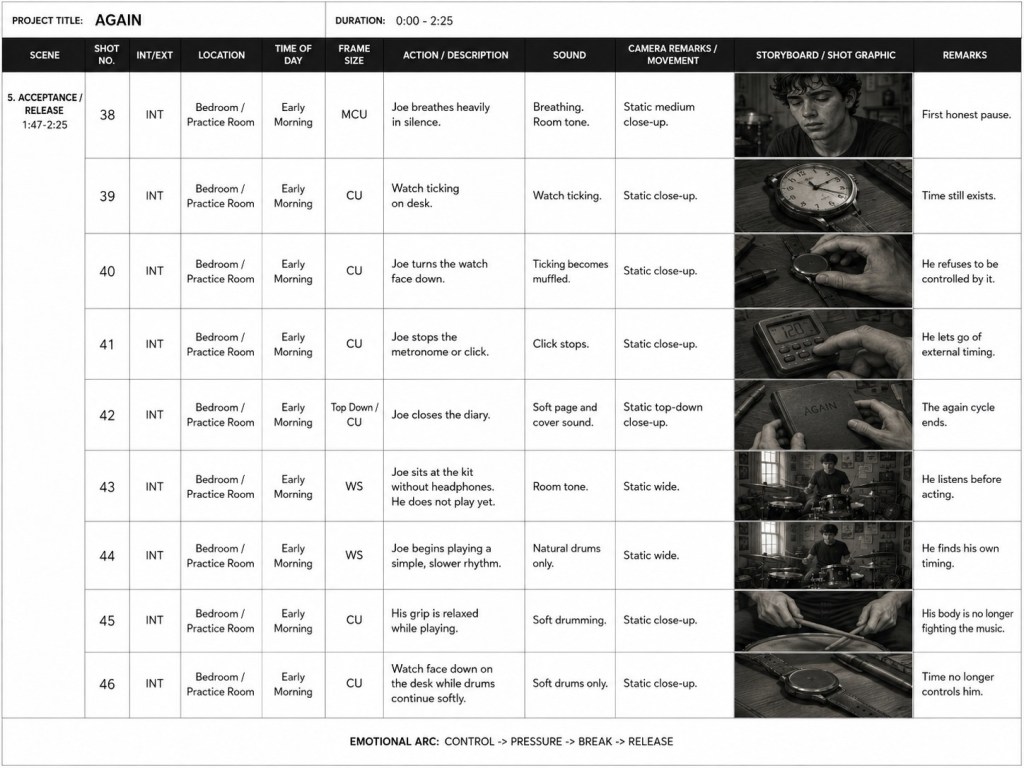
Shot list 3:
5. Acceptance/Release
Shot-List Excel sheet without storyboard elements
Reflection:
For my character study project, I created a short film titled “Again.” This was primarily centered around a young drummer named Joe who is repeatedly trying to record a smooth audition in the confine of his bedroom. The action is simple and straight forward. Joe repeatedly attempts to play one incredibly difficult drum fill with precision and accuracy of a metronome but is shot down time and time again with failure.
His approach towards performing this task reveals his fragile state of mind, his steadfast commitment to discipline and perseverance and the insurmountable pressure he allows to overwhelm him in order to achieve a seemingly unattainable level of perfection.
The film draws inspiration from Ousmane Sembène’s Black Girl, particularly through use of interior voice over and symbolic objects. In Black Girl, Diouanna’s voiceover gives us a glimpse into a world not unveiled fully to the people around her. In addition, the confines of her apartment space become a place of alienation. The emphasis placed on the African marks holds symbolic significance connecting to identity, resistance and displacement. My film does not try to reproduce the post colonial context of Black Girl, however it does draw inspiration from Sebène’s use of an environment and significant objects to symbolize character’s loss of agency. In Again, Joe’s diary, headphones, and drum key carry that same meaningful weight.
The main point of Again is timing. In music particularly, timing is meant to highlight the importance of control, discipline and technical ability. My approach wanted to sway from that idea and rather showcase how timing can become psychological pressure. The ticking, watch, metronome, pencil tapping and drum rhythm all integrate to show Joe’s inner self. At the beginning, these sounds associated with routine and focus but as the film progresses, they become more obsessive. Joe is not just trying to stay in time but simultaneously fighting the enveloping feeling of time running out.
The mise-en-scène was pivotal to Joe’s character development. The cramped bedroom reflective of a greenhorn youthful energy trying to build an identity from a private room. The watch dictating the feeling of inevitability; pressure and deadlines looming. The diary showcasing the repeated failed attempts and self inflicted criticism. The headphones isolate him and get him to focus back on his task ahead while the drum key becomes a symbol of control. When Joe uses it to tighten the skin of the snare drum, he is metaphorically doing the same to himself internally.
The film also represents a broader social context. The deadline and recording set-up portrays a world where creativity is forever measured, submitted and judged. This showcases the productivity driven culture where young people today constantly find themselves wanting to improve; not for their own wellbeing but to be judged less, constantly proving themselves into burnout.
Visually, the use of repetition and close-ups was to highlight how Joe was trapped in a loop. The overhead drum shot given the drum-kit the setting of a cage, showing how something you’re passionate about can quickly turn into a source of pressure. The voiceover was written to add some perseverance rather than just explaining the action.
By the end, Joe turns the watch face down, switches off the metronome, shuts the diary and plays freely as the film transitions from control to acceptance. Joe does not become perfect by the end. But he discovers sometimes being authentic is much more important.


Leave a Reply